MM
Issued to
Mariah McNamara
Want to report a typo or a mistake?
ORDER
Credential Verification
Issue date: August 3, 2026
ID: c8a34106-4dd2-412a-be88-0dbd9cd6d658
Issued by
Alaska Humanities Forum
The Alaska Humanities Forum is a non-profit, non-partisan organization that designs and facilitates experiences to bridge distance and difference.
Type
Course
Level
Foundational
Format
Offline
Duration
2 days
Description
When people in our community disagree with our most deeply held beliefs, it’s easy to see them as threats to a thriving future and to fall into patterns of demonizing and dismissing them. But when we regard large swathes of our fellow community members with that kind of contempt, we are giving up on the democratic ideals our country aspires to. We are giving up on community. When we depolarize we expand our shared sense of belonging, we develop deep connections that transcend common ground, and we practice democracy at its most basic level.
This workshop offers a different path.
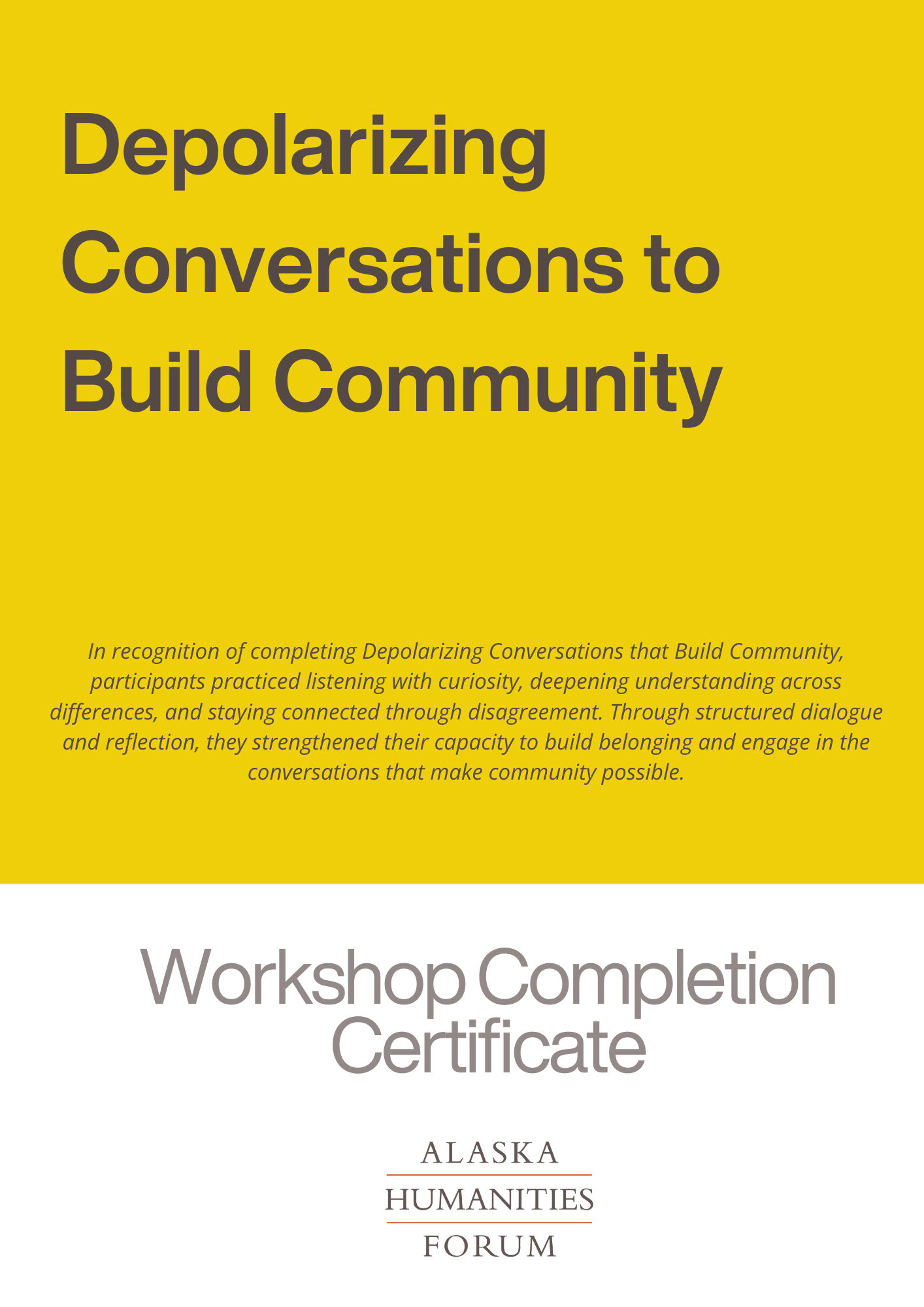
Through a structured and supportive process participants will explore how to remain connected across differences - not by erasing disagreement, but by expanding understanding. When we begin to depolarize, something subtle but powerful happens: curiosity stretches, listening deepens, and the possibility of shared belonging re-enters the room.
This workshop invites participants to slow down, lean into discomfort with intention, and practice the kind of conversations that make community possible in the first place.
By the end of this workshop, we hope you will:
Understand the destructive cycle of conversations and the forces driving polarization in communities today.
Practice active listening and curiosity-driven questioning to more fully understand others’ perspectives.
Widen the lens to recognize the experiences and values that shape how people form their viewpoints.
Practice having real conversations across differences in a supportive, structured environment
As part of the experience, participants will complete a brief pre-survey about their perspectives and beliefs. Using this, facilitators will thoughtfully and carefully pair participants with someone they may disagree with. Through intentional scaffolding and guided practice, participants will engage in real conversations across difference, supported every step of the way.
Participants will not just talk about bridging divides, they will experience what it feels like to stay present, grounded, and in relationship when it matters most.
At the core of this workshop is a simple but profound question: How do we stay in relationship with people we disagree with?