WH
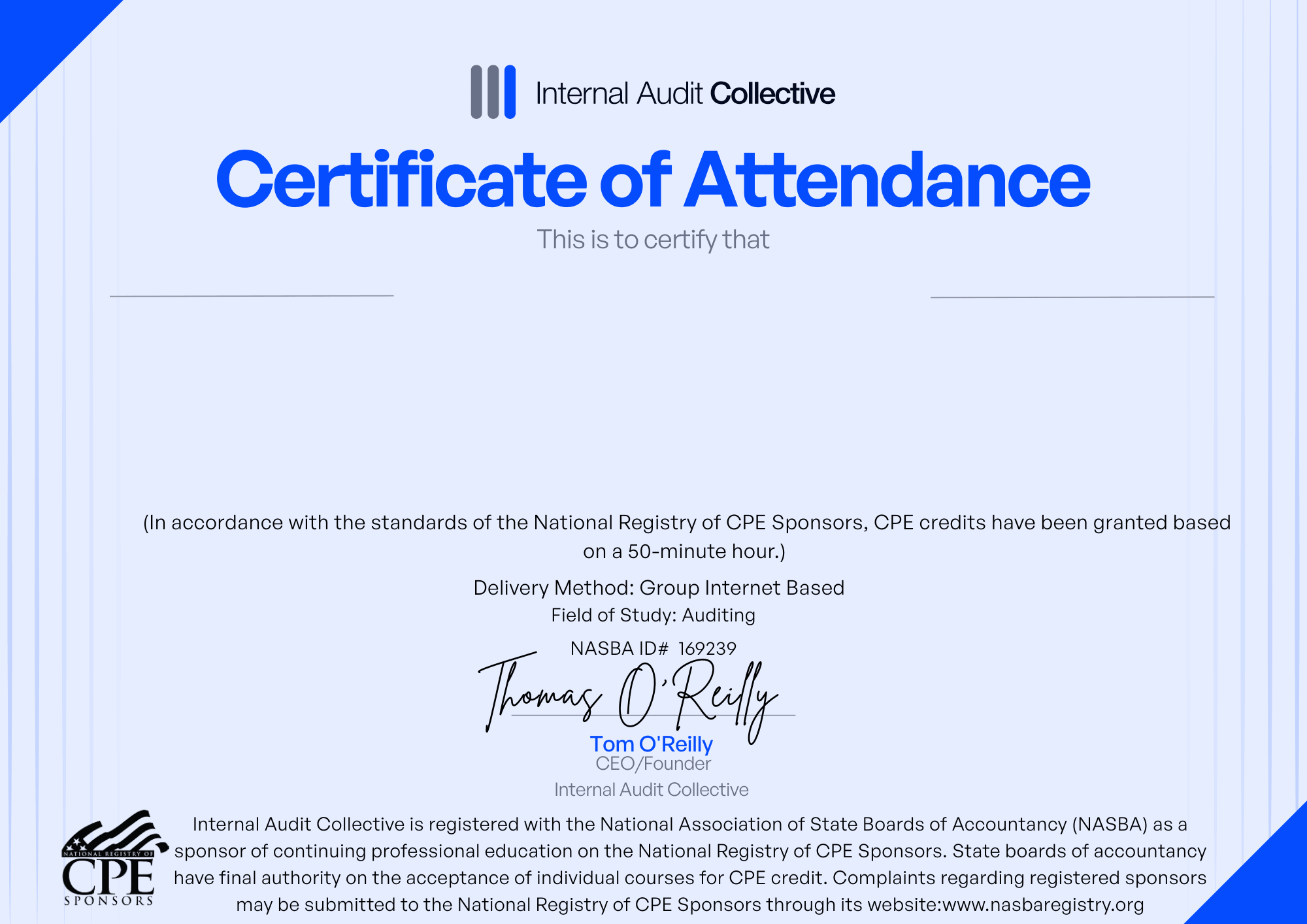
Issued to
warren Harrell
Want to report a typo or a mistake?
Credential Verification
Issue date: November 17, 2026
ID: 32852bd8-2584-4ebe-bee0-55e3fd37c767

Type
Webinar
Level
Introductory
Format
Online
Duration
60 minutes
Price
Free
Description
As AI reshapes how organizations operate, Internal Audit teams face a critical question: should they build their own AI capabilities, buy vendor solutions, or do both?
With vendor capabilities changing quickly and building AI tools easier than ever, many teams are adopting AI piecemeal, without a clear strategy. This session gives Internal Audit leaders and practitioners a practical, vendor-neutral approach to making build-or-buy decisions.
Participants will learn how to classify audit work by task type and evaluate the capabilities, limitations, and maintenance requirements of LLM assistants, simple agents, and complex agentic systems. They will also apply a four-layer decision framework, covering the strategic objective, strategic gate, five decision dimensions, and scoring tools, to real Internal Audit use cases, so that AI investments solve real problems while meeting audit quality and accountability standards.
Learning Objectives:
Upon completion of this program, participants will be able to:
1. Classify Internal Audit activities into the seven task types and identify which tasks are suited to AI assistance and which to AI performing part of the work.
2. Differentiate between LLM assistants, simple agents, and complex agentic systems based on their capabilities, limitations, and build and maintenance requirements.
3. Match Internal Audit tasks to the most appropriate AI tool type based on the nature of the work, the number of systems involved, and the level of reliance placed on the output.
4. Apply a four-layer decision framework to determine whether to build, buy, or adopt a hybrid approach for a specific AI use case.
5. Evaluate AI solutions against the five decision dimensions (Cost, Quality, Accountability, Skill, and Scope), including identifying the risk of false passes in AI-assisted testing.
Skills
Auditing
Related documents