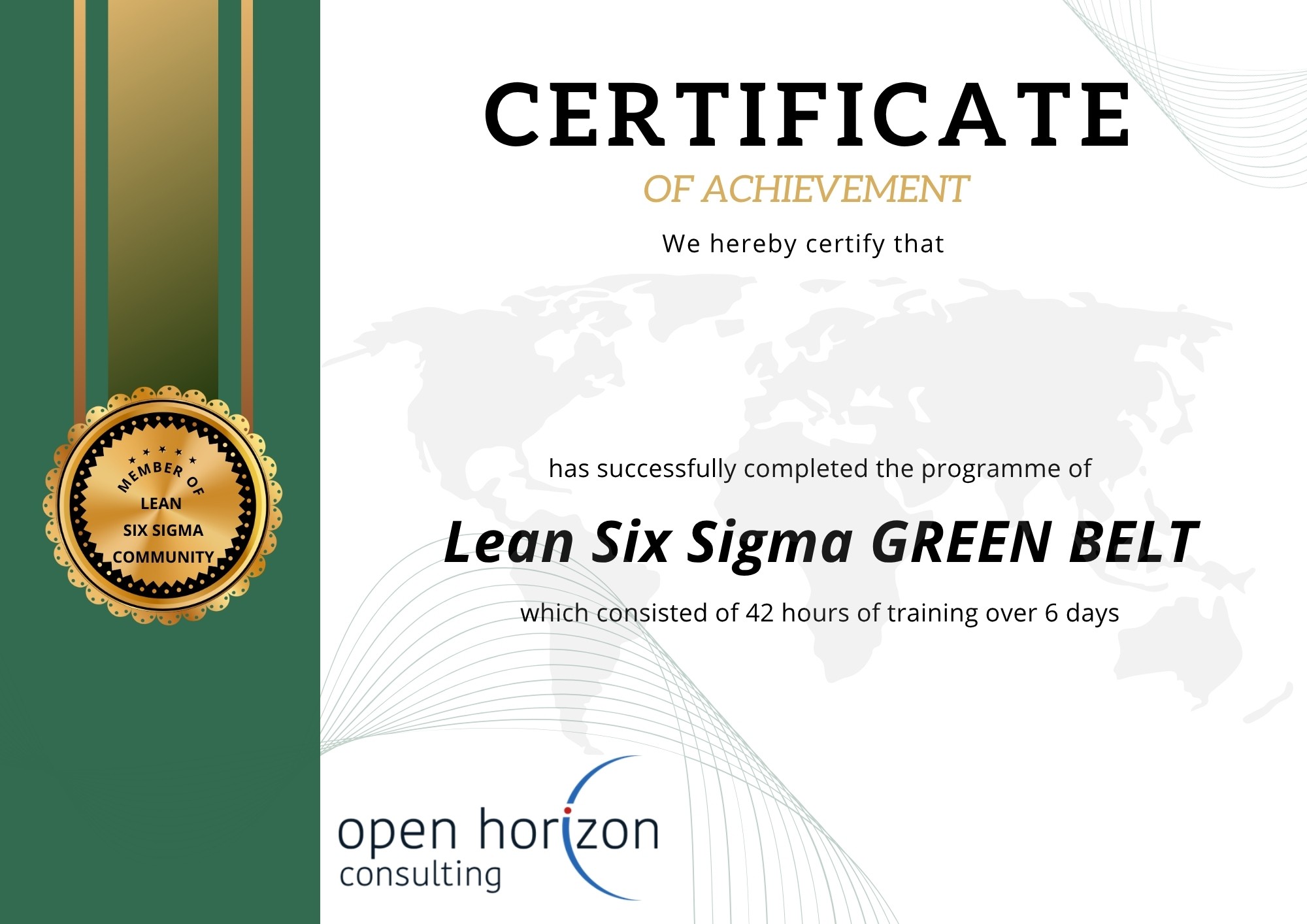
This certificate confirms that the holder has completed the Lean Six Sigma Green Belt training program delivered by Open Horizon Consulting Sp. z o.o. Sp. k. (Poznań, Poland).
The program follows ISO 18404:2015 and ISO 13053:2011, defining competency requirements for Lean and Six Sigma professionals and the standard for conducting DMAIC-based improvement projects (Define, Measure, Analyze, Improve, Control).
Format and duration
● 6 training days (classroom or live online)
● 12-month access to the leaniTY training platform (video lessons, PDF materials, forms, exercises and tests)
Curriculum highlights
● Lean Management fundamentals and the philosophy of continuous improvement (Kaizen)
● The 7+1 types of waste and waste identification
● Value Stream Mapping, Makigami mapping, Lead Time / Cycle Time / Processing Time analysis
● Lean tools: Kanban, SMED, TPM, Poka-Yoke, Jidoka, Standardization, 5S
● Problem-solving methods: PDCA, 8D, A3 Report, DMAIC
● Six Sigma fundamentals and the DMAIC cycle
● Define phase — Project Charter, SIPOC, Voice of the Customer (VOC)
● Measure phase — metrics design, CTQ tree, data collection planning, detailed process mapping (Flow Chart, BPMN 2.0)
● Analyse phase — root cause analysis (Ishikawa Diagram, 5-Why, Pareto Diagram), FMEA (PFMEA/DFMEA), statistical analysis using Minitab: process stability (Run Chart, I-MR), data distribution (histograms, descriptive statistics), process capability (Cp, Cpk, PPM, DPMO, Yield), correlation and linear/multiple regression, statistical tests (ANOVA, Mood's Median, normality tests), sampling methods
● Improve phase — Design of Experiments (DOE, full factorial designs), idea generation techniques (brainstorming, SCAMPER, Six Thinking Hats, decision matrix, MoSCoW, How-How diagram), 5S implementation, implementation planning and project management (implementation plan, schedule, RACI matrix, responsibility assignment and progress monitoring, communication rules, progress reporting and deviation management), pilot testing, process standardization, error-proofing (Poka-Yoke, Jidoka, Andon)
● Control phase — process capability and project benefits assessment, process control plan, control charts for continuous data (X-bar R, X-bar-S) and attribute data (u, c, np, p charts), process auditing, project closure and documentation archiving
More information about the training program: https://openhorizon.com.pl/szkolenie/lean-six-sigma-green-belt/
Skills
Process Improvement
Lean Manufacturing
Six Sigma Methodology
Continuous Improvement
Root Cause Analysis
Statistical Analysis
Data Analysis
Problem Solving
Quality Management
Process Optimization
Business Process Mapping
Operational Excellence
Waste Reduction
Process Control
Project Management
Change Implementation
Earning Criteria
Participation
Attendance — Attended at least 90% of the Lean Six Sigma Green Belt training days.
Test
Final knowledge exam — Passed the final knowledge exam consisting of 75 questions, achieving a minimum score of 45 points (60%).
This certificate confirms that the holder has completed the Lean Six Sigma Green Belt training program delivered by Open Horizon Consulting Sp. z o.o. Sp. k. (Poznań, Poland).
The program follows ISO 18404:2015 and ISO 13053:2011, defining competency requirements for Lean and Six Sigma professionals and the standard for conducting DMAIC-based improvement projects (Define, Measure, Analyze, Improve, Control).
Format and duration
● 6 training days (classroom or live online)
● 12-month access to the leaniTY training platform (video lessons, PDF materials, forms, exercises and tests)
Curriculum highlights
● Lean Management fundamentals and the philosophy of continuous improvement (Kaizen)
● The 7+1 types of waste and waste identification
● Value Stream Mapping, Makigami mapping, Lead Time / Cycle Time / Processing Time analysis
● Lean tools: Kanban, SMED, TPM, Poka-Yoke, Jidoka, Standardization, 5S
● Problem-solving methods: PDCA, 8D, A3 Report, DMAIC
● Six Sigma fundamentals and the DMAIC cycle
● Define phase — Project Charter, SIPOC, Voice of the Customer (VOC)
● Measure phase — metrics design, CTQ tree, data collection planning, detailed process mapping (Flow Chart, BPMN 2.0)
● Analyse phase — root cause analysis (Ishikawa Diagram, 5-Why, Pareto Diagram), FMEA (PFMEA/DFMEA), statistical analysis using Minitab: process stability (Run Chart, I-MR), data distribution (histograms, descriptive statistics), process capability (Cp, Cpk, PPM, DPMO, Yield), correlation and linear/multiple regression, statistical tests (ANOVA, Mood's Median, normality tests), sampling methods
● Improve phase — Design of Experiments (DOE, full factorial designs), idea generation techniques (brainstorming, SCAMPER, Six Thinking Hats, decision matrix, MoSCoW, How-How diagram), 5S implementation, implementation planning and project management (implementation plan, schedule, RACI matrix, responsibility assignment and progress monitoring, communication rules, progress reporting and deviation management), pilot testing, process standardization, error-proofing (Poka-Yoke, Jidoka, Andon)
● Control phase — process capability and project benefits assessment, process control plan, control charts for continuous data (X-bar R, X-bar-S) and attribute data (u, c, np, p charts), process auditing, project closure and documentation archiving